

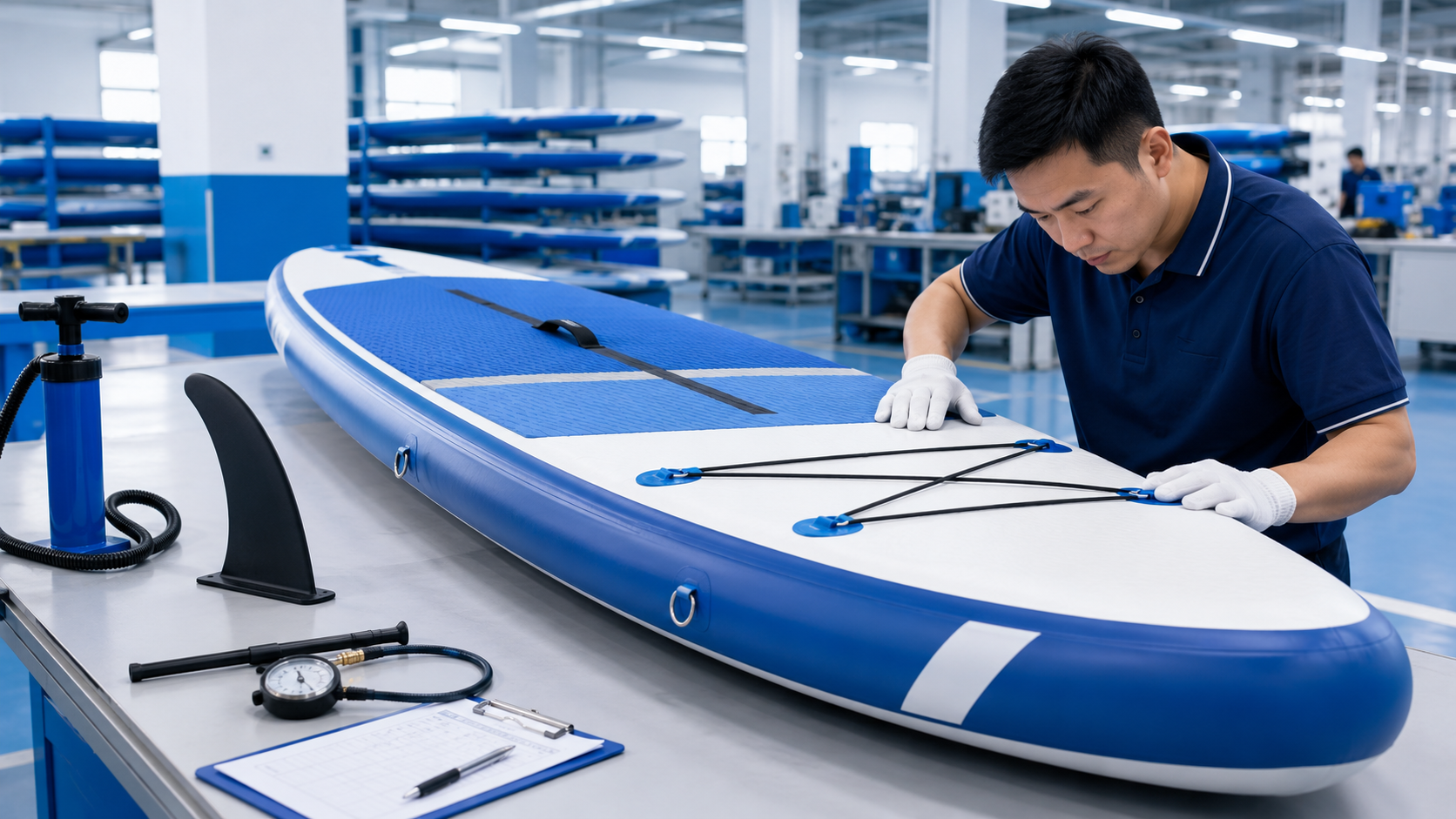

For brands, wholesalers, distributors, and importers, choosing the right inflatable paddle board is not only about appearance or price. Product quality directly affects customer satisfaction, return rates, brand reputation, and long-term profitability.
A high-quality inflatable SUP should offer good rigidity, reliable air retention, durable materials, stable construction, and consistent performance across large production batches.
In this guide, we explain the key factors buyers should check when evaluating the quality of an inflatable paddle board before placing a bulk order.
1. Check the Drop-Stitch Construction
Drop-stitch material is one of the most important structural components of an inflatable paddle board.
Thousands of internal polyester threads connect the top and bottom layers of the board. When the SUP is inflated, these threads help maintain its shape and rigidity.
When evaluating drop-stitch construction, buyers should pay attention to:
- Thread density
- Material consistency
- Surface flatness
- Maximum working pressure
- Overall rigidity after inflation
A well-made board should feel firm under normal operating pressure and should not show excessive bending when supporting a rider.
Poor-quality drop-stitch material may cause deformation, reduced stiffness, or inconsistent board thickness.
2. Evaluate the PVC Material Quality
The outer PVC layer protects the internal structure and affects durability, abrasion resistance, and overall product lifespan.
A reliable inflatable SUP manufacturer should use stable PVC materials with consistent thickness and bonding performance.
Buyers should check:
- PVC thickness
- Surface finish
- Scratch resistance
- UV resistance
- Flexibility
- Bonding quality
For commercial orders, material consistency is especially important. A supplier should be able to maintain similar material standards across different production batches.
3. Inspect the Rail Construction
The rail is the side edge of the paddle board and is one of the most critical areas for air retention.
Many inflatable SUP quality problems occur around the rail because this area must create a strong airtight connection between the top and bottom layers.
When inspecting the rail, look for:
- Smooth bonding
- No visible gaps
- No wrinkles or bubbles
- Consistent edge width
- Reinforced construction where required
Depending on the product design, manufacturers may use single-layer, double-layer, or reinforced rail structures.
For brands targeting higher-end markets, reinforced rail construction can improve durability and stiffness.
4. Check Air Tightness and Pressure Retention
Air leakage is one of the most important quality risks for inflatable paddle boards.
A finished SUP should therefore undergo inflation testing before packing.
A common quality-control method is to inflate the board to the required pressure and keep it inflated for an extended period.
Buyers should ask the supplier about:
- Inflation test pressure
- Test duration
- Leakage inspection process
- Valve inspection
- Pressure-loss standards
At SUPFactoryPro, air-pressure testing should be treated as an essential part of final quality control rather than an optional inspection step.
5. Inspect the Valve Quality
The valve is a relatively small component, but it plays a major role in product reliability.
A poor-quality valve can cause slow leakage, inflation problems, or customer complaints.
A good valve should:
- Seal securely
- Operate smoothly
- Fit firmly into the board
- Resist repeated inflation and deflation
- Be compatible with the supplied pump
Buyers should also confirm whether replacement valves or repair tools can be included in the accessory package.
6. Evaluate EVA Deck Pad Quality
The EVA deck pad affects comfort, grip, appearance, and user experience.
When evaluating EVA quality, check:
- Surface texture
- Thickness
- Adhesion
- Color consistency
- Cutting accuracy
- Pattern alignment
The EVA pad should remain firmly attached to the board and should not lift easily around the edges.
For custom SUP projects, buyers should also confirm whether the factory can support:
- Custom EVA colors
- Custom patterns
- Logo embossing
- Diamond groove patterns
- Different traction textures
This is particularly important for private-label brands that want a more distinctive product appearance.
7. Check Printing and Graphic Quality
Custom graphics are often one of the most visible parts of an OEM or private-label SUP project.
Poor printing quality can immediately reduce the perceived value of the product.
Buyers should inspect:
- Color accuracy
- Print sharpness
- Logo positioning
- Graphic alignment
- Color consistency between boards
- Resistance to fading
Before mass production, it is recommended to confirm artwork through a digital mockup and, when necessary, a physical sample.
This helps reduce the risk of color or layout errors in bulk production.
8. Inspect Handles, D-Rings and Attachment Points
Handles, D-rings, bungee systems, and accessory mounts should be firmly attached.
These parts may experience repeated pulling and loading during normal use.
Check:
- Handle stitching or bonding
- D-ring positioning
- Reinforcement patches
- Bungee cord tension
- Accessory mount stability
For fishing SUPs, touring boards, and other specialized models, attachment points become even more important because users may carry additional equipment.
9. Check the Fin System
The fin system influences tracking, stability, and paddling performance.
Buyers should confirm:
- Fin box quality
- Fin installation accuracy
- Fin material
- Locking mechanism
- Compatibility with replacement fins
The fin should install smoothly and remain secure during use.
For OEM projects, different fin systems may be selected depending on the target market and product positioning.
10. Evaluate Board Dimensions and Shape Consistency
For large orders, consistency between individual boards is essential.
Each unit should meet the agreed specifications for:
- Length
- Width
- Thickness
- Shape
- Rocker
- Weight
- Position of handles and accessories
Even small dimensional differences can affect product performance and packaging.
A reliable SUP factory should have clear inspection standards and production tolerances.
11. Review the Included Accessories
The overall quality of a SUP package also depends on its accessories.
Typical accessories may include:
- Paddle
- Manual pump
- Electric pump
- Backpack
- Leash
- Fin
- Repair kit
Buyers should not evaluate the paddle board alone.
A low-quality pump, weak paddle, or poor backpack can still create negative customer reviews even if the board itself performs well.
For this reason, one-stop sourcing can help buyers maintain more consistent quality across the complete product package.
12. Check Packaging Quality
Good packaging protects the product during international transportation.
For B2B orders, buyers should evaluate:
- Carton strength
- Internal protection
- Product arrangement
- Accessory placement
- Shipping labels
- Barcode labels
- Private-label packaging
- User manual quality
Packaging should protect the board while also presenting the brand professionally.
For private-label customers, packaging customization can include:
- Custom carton artwork
- Color labels
- Hang tags
- Instruction manuals
- Brand stickers
- Retail packaging
13. Ask About the Factory’s Quality Control Process
Product samples are important, but buyers should also evaluate how the factory controls quality during mass production.
A complete quality-control process may include:
- Raw material inspection
- Printing inspection
- Assembly control
- Air-pressure testing
- Appearance inspection
- Accessory inspection
- Final packaging inspection
The goal is not simply to identify defects at the end of production.
Good quality management should detect and prevent problems throughout the manufacturing process.
14. Request a Sample Before Mass Production
For custom inflatable SUP projects, sample development is one of the best ways to reduce purchasing risk.
A typical sample-development process may include:
- Artwork confirmation
- Digital mockup
- Material confirmation
- Physical sample production
- Sample inspection
- Final approval
The buyer can evaluate:
- Board stiffness
- Printing
- Color
- EVA quality
- Accessories
- Dimensions
- Packaging
Only after the sample is approved should the project move into mass production.
15. Evaluate the Supplier, Not Just the Product
A good SUP board is important, but long-term B2B cooperation also depends on the supplier’s ability to deliver consistently.
When selecting an inflatable SUP manufacturer, buyers should consider:
- OEM/ODM experience
- Production capacity
- Quality-control system
- Sample-development support
- Communication efficiency
- Delivery reliability
- Customization capabilities
- Accessory and packaging sourcing
A supplier with complete manufacturing and sourcing capabilities can reduce communication costs and simplify the purchasing process.
Inflatable SUP Quality Checklist for Buyers
Before confirming a bulk order, check the following:
- Drop-stitch material quality
- PVC thickness and durability
- Rail bonding
- Air-pressure retention
- Valve quality
- EVA deck pad
- Printing accuracy
- Handle and D-ring strength
- Fin system
- Board dimensions
- Accessory quality
- Packaging
- Sample approval
- Factory quality-control process
- Delivery capability
Conclusion
Evaluating the quality of an inflatable paddle board requires more than checking its appearance.
For B2B buyers, the most important factors include material quality, construction, air tightness, accessories, production consistency, and the supplier’s quality-control system.
Working with an experienced inflatable SUP manufacturer can help reduce product defects, improve consistency, and support long-term brand growth.
SUPFactoryPro provides OEM/ODM inflatable SUP manufacturing, custom design support, accessories, packaging, quality inspection, and one-stop water sports sourcing solutions for global brands, wholesalers, and distributors.
If you are developing a new inflatable SUP project, send us your product requirements, design ideas, and estimated order quantity to discuss a suitable manufacturing solution.