

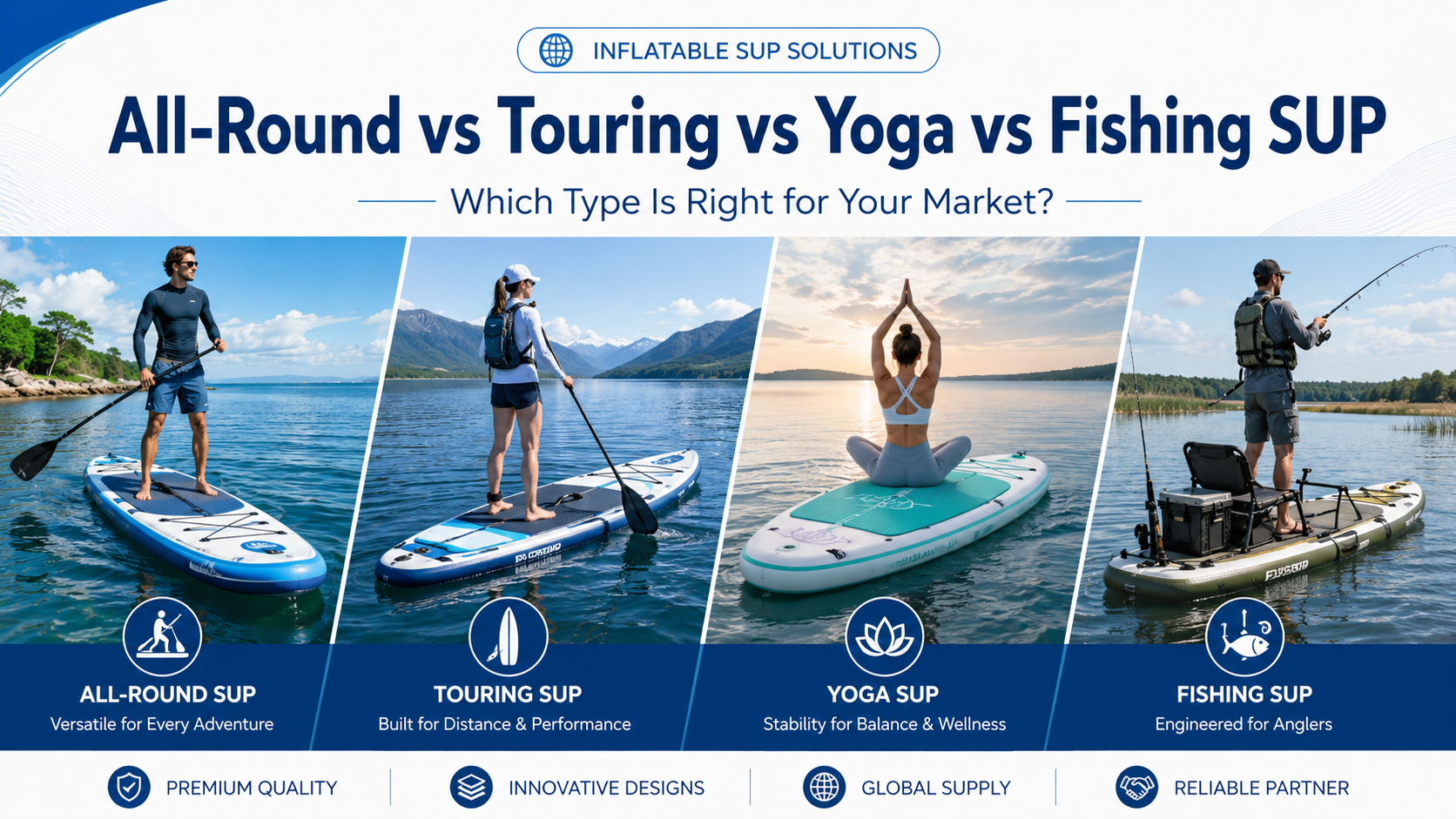

Choosing the right inflatable SUP type is an important decision for brands, wholesalers, distributors, and importers.
Although inflatable paddle boards may look similar at first glance, different SUP designs are developed for different users, water conditions, and activities.
An all-round SUP designed for beginners has very different characteristics from a touring board built for long-distance paddling. Yoga SUPs focus on stability and usable deck space, while fishing SUPs require higher load capacity and additional attachment points.
For B2B buyers, selecting the right product mix can directly affect sales performance, customer satisfaction, inventory turnover, and brand positioning.
In this guide, we compare four popular inflatable SUP categories:
- All-Round SUP
- Touring SUP
- Yoga SUP
- Fishing SUP
We will explain their differences, target customers, customization opportunities, and which type may be more suitable for your market.
1. Why SUP Type Matters for B2B Buyers
When sourcing inflatable paddle boards, it can be tempting to choose a few attractive designs and place an order.
However, successful SUP sourcing starts with understanding your customers.
Different markets may have very different requirements.
For example, a retailer serving first-time recreational paddlers may sell more all-round SUP boards, while an outdoor equipment distributor may have stronger demand for touring or fishing models.
Before selecting your product range, consider:
- Who are your target customers?
- Are they beginners or experienced paddlers?
- Where will they use the boards?
- What price range does your market accept?
- Are customers buying for recreation or specific activities?
- Do they value portability, speed, stability, or carrying capacity?
- Will the products be sold online, through retailers, or through rental businesses?
These questions help determine which SUP category should receive the largest share of your product line.
2. What Is an All-Round SUP?
An all-round SUP is one of the most versatile and widely used inflatable paddle board designs.
It is generally designed to provide a balance between:
- Stability
- Maneuverability
- Speed
- Portability
- Ease of use
Rather than specializing in one particular activity, an all-round board is suitable for many recreational paddling situations.
This makes it especially attractive for beginners and casual users.
Typical All-Round SUP Characteristics
All-round boards commonly feature:
- Rounded or moderately pointed nose
- Medium width
- Stable deck
- General-purpose fin system
- Moderate length
- Standard bungee storage
- Center carry handle
- Lightweight accessory package
The exact specifications can be adjusted depending on the target market.
Who Buys All-Round SUP Boards?
Typical customers include:
- First-time paddlers
- Families
- Casual recreational users
- Holiday users
- Rental businesses
- Entry-level outdoor enthusiasts
Because these customers often prioritize convenience and ease of use, a complete accessory package can be an important selling point.
Why All-Round SUPs Work Well for B2B Markets
For many brands, an all-round SUP is a strong product for entering the paddle board market.
The advantages include:
- Broad customer appeal
- Easy-to-understand positioning
- Suitable for beginners
- Flexible price positioning
- Wide customization possibilities
- Suitable for online and retail sales
If your brand is launching its first inflatable SUP collection, an all-round model is often a practical starting point.
Customization Options for All-Round SUP Boards
OEM all-round SUP projects may include:
- Custom board graphics
- Custom logo
- EVA deck pad colors
- Different board dimensions
- Bungee configuration
- Handle positioning
- D-ring placement
- Paddle selection
- Pump options
- Backpack customization
- Private-label packaging
This makes the category particularly suitable for brands that want visually distinctive products without developing a highly specialized board.
3. What Is a Touring SUP?
A touring SUP is designed primarily for longer-distance paddling and improved tracking.
Compared with an all-round board, touring boards generally have a more streamlined shape.
One of the most noticeable differences is the nose.
Touring boards often use a more pointed nose to help the board move through the water efficiently.
Typical Touring SUP Characteristics
Touring boards may feature:
- Pointed nose
- Longer board length
- Narrower or streamlined profile
- Improved directional tracking
- Larger storage area
- Higher carrying capacity
- Performance-oriented fin configuration
These features help paddlers travel longer distances with fewer corrections.
Who Buys Touring SUP Boards?
Typical customers include:
- Intermediate paddlers
- Experienced recreational paddlers
- Adventure travelers
- Long-distance paddlers
- Outdoor enthusiasts
- Customers carrying camping equipment
Touring buyers are generally more interested in performance than entry-level recreational users.
Why Touring SUPs Can Support Premium Positioning
Touring boards often allow brands to move into a higher-value market segment.
Customers may be willing to pay more for:
- Better tracking
- Improved rigidity
- Premium materials
- Better paddles
- Larger backpacks
- Extra storage capacity
- Advanced fin systems
This creates opportunities for higher product differentiation.
For established SUP brands, adding a touring model can help expand beyond entry-level products.
Touring SUP Customization Options
OEM touring boards can be customized with:
- Board length and width
- Nose profile
- Tail design
- Reinforced construction
- Front and rear cargo areas
- Extra D-rings
- Multiple handles
- Premium EVA deck pad
- Fin systems
- High-performance paddles
- Branded accessories
The specifications should match the performance expectations of your target customers.
4. What Is a Yoga SUP?
A Yoga SUP is designed for yoga, fitness, stretching, and stability-focused activities on the water.
Unlike touring boards, speed is usually not the main priority.
The goal is to create a stable platform with enough usable deck space for movement.
Typical Yoga SUP Characteristics
Yoga boards often include:
- Wider deck
- Stable board shape
- Large EVA deck pad
- Soft and comfortable deck surface
- Minimal obstruction on the standing area
- Balanced handle placement
- Multiple D-rings
- Optional anchor attachment points
The wide platform gives users more space for yoga poses and exercises.
Who Buys Yoga SUP Boards?
Typical target users include:
- Yoga enthusiasts
- Fitness users
- Wellness customers
- SUP yoga schools
- Resorts
- Fitness studios
- Rental operators
The product can also appeal strongly to lifestyle-oriented markets.
Why Yoga SUPs Offer Strong Branding Opportunities
Yoga and fitness products are often highly visual.
This gives brands significant customization opportunities.
Popular design directions may include:
- Minimalist graphics
- Natural color palettes
- Wellness-inspired designs
- Custom EVA patterns
- Large logo placement
- Coordinated accessories
A yoga SUP can therefore become more than a sports product—it can be positioned as part of a lifestyle collection.
Yoga SUP Customization Options
Brands may customize:
- Board width
- Deck dimensions
- EVA coverage
- EVA texture
- Graphic style
- Handle position
- D-rings
- Anchor points
- Paddle
- Carry bag
- Packaging
For yoga applications, special attention should be paid to deck comfort and usable surface area.
5. What Is a Fishing SUP?
A Fishing SUP is designed to support anglers and additional fishing equipment.
Compared with general recreational boards, fishing SUPs usually prioritize:
- Stability
- Load capacity
- Equipment storage
- Attachment options
Fishing customers may carry rods, tackle boxes, coolers, seats, and other gear.
The board therefore needs to function as a practical fishing platform.
Typical Fishing SUP Characteristics
Fishing boards may include:
- Wider platform
- High load capacity
- Multiple D-rings
- Fishing rod holders
- Accessory mounts
- Large cargo storage
- Reinforced attachment points
- Kayak seat compatibility
- Multiple handles
- Stable fin configuration
Some designs may also include mounting systems for specialized fishing accessories.
Who Buys Fishing SUP Boards?
Typical customers include:
- Recreational anglers
- Outdoor enthusiasts
- Fishing equipment customers
- Adventure users
- Specialist water-sports retailers
Fishing SUPs tend to target a more defined customer segment than all-round boards.
Why Fishing SUPs Can Create Higher Product Value
Fishing SUP products often include more components and specialized features.
This creates opportunities for higher average selling prices.
A complete fishing SUP package might include:
- Paddle
- Pump
- Backpack
- Fin
- Leash
- Kayak seat
- Rod holders
- Additional mounts
- Storage accessories
This allows brands to sell a more complete solution rather than only the board itself.
6. All-Round vs Touring vs Yoga vs Fishing SUP: Key Differences
The easiest way to understand the four categories is to compare their primary purposes.
| SUP Type | Main Purpose | Stability | Speed | Main Customer |
|---|---|---|---|---|
| All-Round SUP | General recreation | High | Medium | Beginners & families |
| Touring SUP | Distance paddling | Medium–High | High | Intermediate & advanced users |
| Yoga SUP | Yoga & fitness | Very High | Low–Medium | Wellness & fitness users |
| Fishing SUP | Fishing & equipment carrying | Very High | Low–Medium | Anglers & outdoor users |
These are general positioning differences rather than fixed technical rules.
Individual board specifications can be adjusted during OEM/ODM development.
7. Which SUP Type Is Best for Beginner Markets?
For beginner-focused markets, the all-round SUP is usually the strongest starting point.
Beginner buyers typically prioritize:
- Stability
- Easy inflation
- Simple accessories
- Portability
- Affordable pricing
- Attractive graphics
They may not yet understand technical SUP specifications.
Therefore, simple product positioning is important.
For example:
“Stable inflatable paddle board for beginners and recreational use.”
This is easier for consumers to understand than a highly technical product description.
8. Which SUP Type Is Better for Premium Markets?
Touring SUPs can be particularly suitable for premium or performance-focused product lines.
These customers may compare:
- Board weight
- Rigidity
- Tracking performance
- Fin design
- Construction
- Paddle materials
- Accessory quality
A premium touring package can use upgraded accessories and materials to create stronger differentiation.
Brands can also offer both an all-round entry model and a touring premium model to cover multiple price segments.
9. Which SUP Type Is Best for Lifestyle Brands?
For brands focused on wellness, lifestyle, social media, or visually driven audiences, Yoga SUP can provide interesting positioning opportunities.
The large deck pad creates space for distinctive graphics and color combinations.
Potential target channels include:
- Yoga studios
- Resorts
- Wellness brands
- Outdoor lifestyle retailers
- Social-media-driven consumer brands
Yoga SUP products can also be bundled with complementary accessories to create a complete lifestyle package.
10. Which SUP Type Is Best for Specialist Outdoor Markets?
Fishing SUPs are well suited to specialized outdoor markets.
Unlike a generic recreational board, the product can be developed around a specific activity.
This makes marketing more focused.
Instead of simply advertising:
“Inflatable Paddle Board”
a brand can promote:
“Inflatable Fishing SUP with Rod Holders, Kayak Seat and Extra Storage.”
The product proposition is immediately clearer.
Specialized features can also reduce direct price comparison with basic entry-level SUP boards.
11. Should Your Brand Sell More Than One SUP Type?
In many cases, yes.
A balanced product line might include:
Entry Level
All-Round SUP
Performance
Touring SUP
Lifestyle
Yoga SUP
Specialist
Fishing SUP
This allows one brand to target several customer groups without relying on a single product.
However, this does not mean new buyers should immediately order many different models.
If you are entering the market for the first time, it may be better to begin with one or two core categories.
You can expand the range after identifying which products perform best.
12. How to Choose Your Product Mix
For B2B buyers, product mix should be based on market demand rather than personal preference.
Consider several factors.
Target Customer
Who is actually buying the product?
Beginners and families may prefer all-round boards, while serious outdoor customers may be interested in touring or fishing SUPs.
Selling Price
Determine the retail price your market can support.
Your target retail price influences:
- Material selection
- Accessories
- Packaging
- Construction
- Product features
Sales Channel
Different channels may require different products.
E-commerce
Visually attractive all-round or yoga SUPs can work well where design and complete packages influence purchasing decisions.
Outdoor Retail
Touring and fishing boards may be more appropriate when customers understand product specifications.
Rental Businesses
Durability, stability, and simple maintenance may be more important than complex customization.
Resorts and Clubs
Custom branding and consistent product appearance may be particularly valuable.
13. Consider Accessories When Choosing a SUP Category
Accessories can significantly influence the final product positioning.
A standard SUP package may include:
- Paddle
- Manual pump
- Backpack
- Leash
- Fin
- Repair kit
Different markets may require different configurations.
For example:
All-Round Package
A cost-effective paddle, hand pump, backpack, fin, and leash.
Touring Package
A lighter performance paddle, upgraded backpack, and premium fin.
Yoga Package
Comfortable accessories with coordinated colors and optional anchor equipment.
Fishing Package
Kayak seat, rod holders, extra mounts, and storage solutions.
This is why working with a manufacturer that can provide one-stop accessory sourcing can make product development easier.
14. Packaging Should Match the Product Positioning
Packaging should also reflect the product category.
An entry-level all-round board may use simple branded packaging.
A premium touring board may benefit from stronger branding and more detailed product information.
A lifestyle-focused Yoga SUP package can use coordinated:
- Cartons
- Hang tags
- Manuals
- Labels
- Color schemes
Fishing SUP packaging may need to accommodate a larger number of accessories.
For private-label projects, packaging should be considered during product development rather than at the last minute.
15. Test Samples Before Choosing Your Final Models
Photos and specifications are useful, but physical samples are important when comparing different SUP types.
Before mass production, evaluate:
- Stability
- Rigidity
- Board dimensions
- EVA comfort
- Graphic quality
- Handle positioning
- Fin system
- Accessory quality
- Packing method
If you are comparing an all-round board with a touring model, physically testing both products can help you understand the difference in performance.
Sample development also gives you an opportunity to adjust product details before mass production.
16. Work With a Manufacturer That Supports Different SUP Categories
A manufacturer capable of producing multiple SUP categories can make it easier to expand your product line.
Rather than working with separate suppliers for:
- All-round SUP
- Touring SUP
- Yoga SUP
- Fishing SUP
you may be able to manage these categories through one manufacturing partner.
This can simplify:
- Artwork management
- Material selection
- Quality control
- Accessory sourcing
- Packaging
- Production scheduling
- Shipping
It can also help maintain more consistent branding across the complete product range.
Which Inflatable SUP Is Right for Your Market?
There is no single SUP type that is best for every business.
The right choice depends on your target customers and positioning.
Choose an All-Round SUP if:
Your customers are beginners, families, recreational users, or you need a versatile entry-level product.
Choose a Touring SUP if:
Your market values speed, tracking, longer-distance performance, and premium specifications.
Choose a Yoga SUP if:
Your target customers are interested in wellness, fitness, yoga, resorts, or lifestyle products.
Choose a Fishing SUP if:
You serve anglers and outdoor customers who need additional stability, storage, and accessory mounting options.
For many brands, the best strategy is not choosing only one category, but building a carefully planned collection based on different customer groups.
Inflatable SUP Selection Checklist for B2B Buyers
Before choosing your products, confirm:
- Target customer
- Main paddling activity
- Target retail price
- Required board dimensions
- Stability requirements
- Performance requirements
- Load capacity
- Custom graphics
- EVA requirements
- Accessory package
- Packaging
- MOQ
- Sample requirements
- Production lead time
- Target sales channel
These factors will help your SUP manufacturer recommend suitable board specifications.
FAQ
What is the most popular inflatable SUP type for beginners?
All-round SUP boards are generally the most beginner-friendly option because they are designed to balance stability, maneuverability, and ease of use.
What is the difference between an all-round SUP and a touring SUP?
All-round SUP boards focus on versatility and stability, while touring SUP boards typically use a longer and more streamlined design for improved tracking and distance paddling.
Are Yoga SUP boards wider than regular paddle boards?
Yoga-oriented SUP designs are often wider and provide a larger usable deck area to improve stability during yoga and fitness activities.
What makes a Fishing SUP different?
Fishing SUP boards typically provide greater stability, higher carrying capacity, additional D-rings, storage areas, and mounts for fishing equipment.
Can different SUP types be customized for private-label brands?
Yes. OEM/ODM projects can typically customize board dimensions, graphics, EVA deck pads, handles, attachment points, fins, accessories, and private-label packaging according to the project requirements.
Conclusion
Choosing between an All-Round SUP, Touring SUP, Yoga SUP, and Fishing SUP should start with understanding your market.
For most entry-level and recreational markets, all-round SUP boards provide broad customer appeal.
Touring SUPs can support performance and premium product lines, while Yoga SUPs are ideal for lifestyle and wellness positioning. Fishing SUPs provide opportunities in specialized outdoor markets where customers value stability, load capacity, and equipment compatibility.
For B2B buyers, the best product is not necessarily the board with the most features. It is the board that matches your customers, target price, sales channel, and brand positioning.
SUPFactoryPro supports OEM/ODM inflatable SUP development across different product categories, including custom graphics, board specifications, EVA deck pads, accessories, private-label packaging, and one-stop sourcing support.
If you are planning a new inflatable SUP collection, share your target market, product category, estimated quantity, and customization requirements with our team to develop a suitable solution for your brand.