
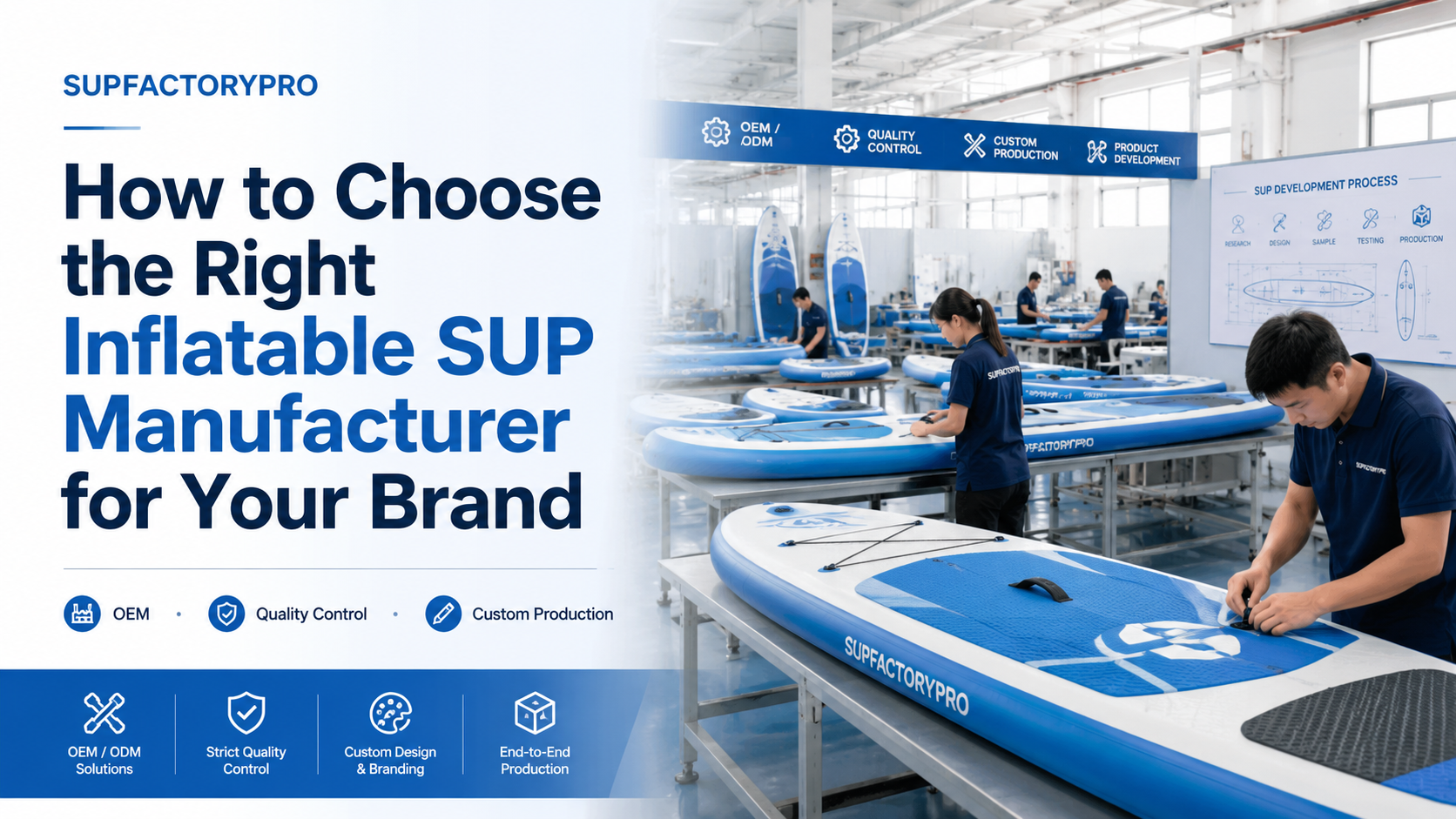

Choosing the right inflatable SUP manufacturer is one of the most important decisions for brands, wholesalers, distributors, and importers entering or expanding in the paddle board market.
A reliable supplier does more than simply manufacture boards. The right manufacturing partner should help you develop products, control quality, customize designs, manage accessories and packaging, and deliver orders consistently.
For B2B buyers, price is important—but it should not be the only factor.
In this guide, we explain what to look for when selecting an inflatable SUP manufacturer and how to reduce purchasing risks before placing a bulk order.
1. Understand Your Product Requirements First
Before contacting a SUP manufacturer, it is important to clearly understand what type of product you want to develop.
Inflatable paddle boards come in different shapes, sizes, constructions, and applications.
Common product categories include:
- All-round SUP boards
- Touring SUP boards
- Yoga SUP boards
- Fishing SUP boards
- Race SUP boards
- Kids SUP boards
- Custom inflatable paddle boards
You should also consider your target market.
For example, an entry-level retail brand may focus on competitive pricing and complete accessory packages, while a premium outdoor brand may require better materials, custom EVA deck pads, reinforced construction, and stronger packaging.
Before requesting a quotation, prepare some basic information such as:
- Board type
- Board dimensions
- Target quantity
- Target market
- Logo and graphic requirements
- Required accessories
- Packaging requirements
- Target price range
The clearer your requirements are, the easier it will be for the manufacturer to recommend a suitable solution.
2. Look for Real OEM and ODM Capabilities
Not every supplier that sells inflatable paddle boards has strong customization capabilities.
For brands that want to build their own product line, OEM and ODM support is especially important.
What Is OEM SUP Manufacturing?
OEM manufacturing means the factory produces inflatable SUP boards according to your specifications, designs, branding, and requirements.
Typical OEM customization may include:
- Custom logo
- Custom graphics
- Custom board dimensions
- EVA deck pad design
- Handle position
- D-ring configuration
- Fin system
- Accessory selection
- Private-label packaging
What Is ODM SUP Manufacturing?
ODM support usually goes one step further.
If you do not already have a complete product specification, the manufacturer can help develop the product based on your market positioning and target customers.
This may include recommendations for:
- Board shape
- Size
- Construction
- Materials
- Accessories
- Packaging
- Product positioning
A manufacturer with both OEM and ODM capabilities gives buyers more flexibility when developing a new product line.
3. Evaluate the Manufacturer’s Customization Options
Customization is one of the main reasons brands choose direct factory cooperation.
A capable custom inflatable SUP manufacturer should be able to support more than simply printing your logo on an existing board.
You should ask what elements can be customized.
Board Shape and Size
Different markets require different SUP designs.
A manufacturer should be able to adjust:
- Length
- Width
- Thickness
- Nose shape
- Tail shape
- Rocker
- Volume
These factors affect stability, speed, tracking, and overall user experience.
Graphics and Branding
For private-label brands, appearance is extremely important.
Customization may include:
- Full-board graphics
- Logo placement
- Color matching
- Side rail printing
- EVA graphics
- Packaging artwork
Before production, the manufacturer should provide a digital mockup for confirmation.
EVA Deck Pad
The EVA deck pad can also be customized in terms of:
- Color
- Texture
- Pattern
- Groove design
- Logo
- Shape
A distinctive EVA design can help improve brand recognition.
Handles and Attachment Points
Depending on the board type, buyers may need:
- Center handles
- Front handles
- Rear handles
- D-rings
- Bungee systems
- Action camera mounts
- Fishing mounts
- Kayak seat attachment points
A flexible factory should be able to modify these components according to your product requirements.
4. Check Material Quality
Material quality directly affects the performance, durability, and lifespan of an inflatable paddle board.
When evaluating a SUP manufacturer, ask about the materials used in production.
Drop-Stitch Material
Drop-stitch construction is the internal structure that allows an inflatable board to maintain its shape under pressure.
Important factors include:
- Thread density
- Surface consistency
- Board rigidity
- Maximum operating pressure
Poor-quality drop-stitch material may lead to deformation or insufficient stiffness.
PVC Material
The outer PVC layer provides protection and structural strength.
Buyers should consider:
- PVC thickness
- Abrasion resistance
- Bonding performance
- Surface finish
- UV resistance
Material consistency is especially important for large-volume orders.
A reliable manufacturer should maintain stable specifications across different production batches.
5. Review the Factory’s Quality Control Process
One of the biggest differences between suppliers is how they manage quality control.
A professional inflatable SUP factory should inspect products throughout the manufacturing process rather than only checking finished boards.
A typical quality control process may include:
Raw Material Inspection
PVC, drop-stitch materials, EVA, valves, D-rings, and accessories should be inspected before production.
Printing Inspection
Graphics should be checked for:
- Color accuracy
- Position
- Sharpness
- Alignment
Assembly Inspection
During assembly, workers should monitor:
- Bonding
- Rail construction
- Valve installation
- Handle positioning
- Attachment points
Inflation Testing
Finished boards should be inflated and tested for air retention.
This is one of the most important quality control steps for inflatable SUP products.
Final Inspection
Before packing, the factory should inspect:
- Appearance
- Dimensions
- Accessories
- Printing
- Packaging
- Product completeness
A clear QC system reduces the risk of receiving defective products after shipment.
6. Ask About Sample Development
For custom SUP projects, buyers should avoid moving directly into mass production without confirming a sample.
A professional factory should support sample development before bulk production.
A typical sample process may include:
- Artwork confirmation
- Digital mockup
- Material confirmation
- Sample production
- Sample inspection
- Buyer approval
- Mass production
A physical sample allows you to evaluate:
- Product appearance
- Board stiffness
- Material quality
- Printing quality
- EVA texture
- Accessories
- Packaging
Sample approval can significantly reduce misunderstandings and production risks.
7. Evaluate Production Capacity
Production capacity becomes especially important when your business begins to scale.
A factory may be able to handle small orders, but larger seasonal orders require stronger production planning and supply chain management.
Ask potential suppliers about:
- Factory size
- Number of production lines
- Number of workers
- Monthly production capacity
- Peak-season lead times
- Production scheduling
- Order management
You should also ask what happens during the peak paddle board season.
A reliable manufacturer should be able to explain how they manage large orders and production schedules.
For growing brands, stable supply is often more important than obtaining the lowest possible unit price.
8. Check the Manufacturer’s Accessory Sourcing Capability
An inflatable SUP is rarely sold alone.
A complete package commonly includes:
- Paddle
- Manual pump
- Electric pump
- Leash
- Backpack
- Fin
- Repair kit
If you need to source every accessory from a different supplier, the purchasing process becomes much more complicated.
Working with a manufacturer that can provide one-stop SUP sourcing can simplify:
- Procurement
- Quality control
- Packaging
- Logistics
- Communication
It also makes it easier to create complete retail packages for different market segments.
9. Consider Private Label Packaging Support
Packaging is an important part of your brand experience.
For wholesalers and private-label brands, generic cartons may not be enough.
Ask whether your SUP manufacturer can support:
- Custom cartons
- Color labels
- Hang tags
- Instruction manuals
- Barcode labels
- Brand stickers
- Bundled accessory packaging
Good packaging should serve two purposes:
Protect the product during transportation and present your brand professionally to the end customer.
If you sell through retail stores, distributors, or e-commerce channels, packaging design becomes even more important.
10. Compare Communication and Response Efficiency
Communication is often underestimated when choosing a manufacturer.
Even a factory with good production capability can become difficult to work with if communication is slow or unclear.
During the quotation and sample stage, pay attention to:
- Response speed
- Understanding of your requirements
- Technical knowledge
- Ability to suggest solutions
- Accuracy of quotations
- Follow-up efficiency
A good supplier should not simply answer:
“Yes, we can do it.”
They should be able to explain how the product will be manufactured and recommend appropriate options based on your requirements.
Good communication becomes even more important when dealing with custom projects.
11. Do Not Choose a Manufacturer Based Only on Price
It is natural for B2B buyers to compare quotations from multiple suppliers.
However, the lowest price does not always mean the lowest total cost.
A cheaper product may result in:
- Higher defect rates
- Air leakage
- Poor printing
- Weak accessories
- Damaged packaging
- Customer complaints
- Returns
- Brand reputation problems
Instead of comparing price alone, compare the complete offer.
Consider:
- Materials
- Construction
- Accessories
- Packaging
- Testing
- Customization
- Lead time
- Quality control
- After-sales support
The goal should be to find the best balance between cost, quality, and reliability.
12. Ask About Minimum Order Quantity
MOQ is another important factor when selecting an inflatable SUP manufacturer.
Different factories may have different minimum order requirements depending on:
- Board model
- Custom graphics
- Material
- Packaging
- Accessories
- Production method
If you are launching a new brand, you may prefer a supplier that can support smaller trial orders.
As your sales grow, you can gradually increase order quantities.
Before confirming a project, ask about:
- MOQ per design
- MOQ per color
- MOQ for custom packaging
- Sample quantity
- Mixed-model orders
Flexible MOQ options can be particularly useful for startups and new product launches.
13. Confirm Production Lead Time
Timing is especially important in seasonal markets such as paddle sports.
If your goods arrive after the main selling season, even a good product may become difficult to sell.
Ask your manufacturer about:
- Sample lead time
- Production lead time
- Peak-season lead time
- Packaging preparation time
- Estimated shipping schedule
You should also allow additional time for:
- Sample approval
- Artwork changes
- Packaging confirmation
- Quality inspection
- International shipping
Planning early can help reduce the risk of missing your target sales season.
14. Evaluate Shipping and Delivery Support
Manufacturing is only one part of the supply chain.
For international buyers, delivery capability is also important.
A supplier with export experience should be familiar with:
- Carton preparation
- Container loading
- Shipping documents
- Freight coordination
- Export packaging
- Delivery scheduling
Depending on your business model, you may require:
- Sea freight
- Air freight
- Express shipping
- Consolidated shipments
Discuss these requirements before placing your order.
15. Check Whether the Supplier Can Grow With Your Business
Your first order may be small, but your future orders may be much larger.
The right SUP manufacturer should be able to support your business as it grows.
Ask yourself whether the supplier can help with:
- New product development
- Additional board models
- New accessories
- Packaging upgrades
- Larger order volumes
- Seasonal production planning
- Product line expansion
A long-term manufacturing partner can reduce the time and cost required to repeatedly find new suppliers.
Inflatable SUP Manufacturer Checklist for Buyers
Before choosing a supplier, evaluate the following:
- OEM and ODM capability
- Custom SUP design options
- Drop-stitch and PVC materials
- Quality control process
- Air pressure testing
- Sample development
- Production capacity
- MOQ flexibility
- Accessory sourcing
- Private-label packaging
- Communication efficiency
- Production lead time
- Export experience
- Delivery capability
- Long-term cooperation potential
If a manufacturer can provide clear answers in these areas, it is generally easier to evaluate whether they are suitable for your project.
Questions to Ask an Inflatable SUP Manufacturer
Before placing an order, consider asking these questions:
What SUP products can you manufacture?
Confirm whether the supplier produces the board types you need and whether custom shapes are available.
Can you support OEM and ODM projects?
Ask what design, construction, graphics, accessories, and packaging elements can be customized.
What materials do you use?
Request information about drop-stitch, PVC, EVA, valves, and other major components.
What is your quality control process?
Ask whether every board undergoes inflation testing and final inspection.
Can you produce a sample before mass production?
Sample confirmation is especially important for customized orders.
What is your MOQ?
Confirm MOQ requirements for boards, colors, designs, accessories, and packaging.
What is your production lead time?
Make sure the schedule matches your purchasing plan.
Can you provide accessories and packaging?
A one-stop supplier can simplify purchasing and reduce coordination work.
Why Work With a Direct Inflatable SUP Manufacturer?
Working directly with a factory can provide several advantages for B2B buyers.
These may include:
- More customization options
- Direct technical communication
- Better control over product specifications
- Easier sample development
- More flexible packaging
- Integrated accessory sourcing
- Better production visibility
For brands developing a long-term product line, direct manufacturer cooperation can also make future product development more efficient.
Conclusion
Choosing the right inflatable SUP manufacturer requires more than comparing product photos and unit prices.
A strong manufacturing partner should provide reliable materials, consistent quality control, flexible customization, sample development, accessory sourcing, packaging support, stable production, and dependable delivery.
For brands, wholesalers, distributors, and importers, these factors can directly affect customer satisfaction and long-term business growth.
SUPFactoryPro supports OEM and ODM inflatable SUP projects, including custom board design, graphics, EVA deck pads, accessories, private-label packaging, quality inspection, and one-stop water sports sourcing.
If you are developing a new SUP product line or looking for a long-term manufacturing partner, contact our team with your product requirements, target quantity, and customization ideas.
Start your inflatable SUP project with SUPFactoryPro.